
What’s Going On With Your Windows?

Have you noticed moisture collecting on your windows — especially in the morning? This isn’t just messy or annoying: it’s a sign your home may have a moisture imbalance. When warm, humid indoor air hits a cold window surface, it cools rapidly, turning the excess water vapour into liquid — and your windows condensate, or ‘sweat’. This is most common in winter, when indoor air is warm and outdoor temperatures are freezing. But it can happen anytime there’s a large temperature difference between inside and outside. If your windows are consistently wet, your house may be trapping in more moisture than it should.
What Does it Mean for Your Home to ‘Breathe Properly’?
Modern homes are built to be airtight. That’s great for energy efficiency — but it also means your home might not be able to naturally “breathe”.
Your home relies on two things to stay balanced:
• Airflow – Fresh air coming in, stale and moist air going out.
• Ventilation systems – Units like HRVs and ERVs exchange indoor and outdoor air without losing heat.
If that system isn’t sized correctly, installed properly, or balanced to match your home’s moisture levels, indoor air becomes trapped — and humidity builds up.
Why Moisture Builds Up in Winter
In winter, your home produces more moisture than you might realize:
• Cooking and dishwashing
• Showers and baths
• Drying clothes indoors
• Breathing (people add moisture just by living in the space)
In older homes, that moisture escaped through drafts and leaks. In today’s tighter homes, it stays inside. When that trapped moisture meets cold window glass, condensation forms — and your windows start sweating.
HRV vs ERV — Do They Help?
Both systems are designed to improve indoor air quality, but work in slightly different ways.
HRV (Heat Recovery Ventilator)
• Transfers heat between outgoing and incoming air
• Best suited for cold, dry climates
• Does not transfer moisture
ERV (Energy Recovery Ventilator)
• Transfers both heat and some moisture
• Helps regulate humidity levels
• Often used in homes with moisture concerns
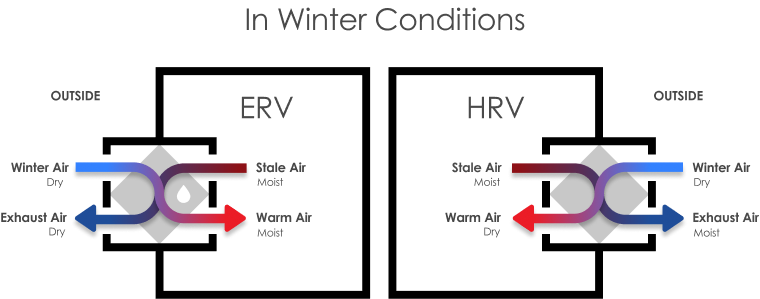
In winter conditions ERV systems help maintain specified moisture levels inside while filtering out indoor air. Heat is partly transferred through the moisture of ERV systems, maintaining an ideal indoor climate through both temperature and air moisture regulation.
Ideal for older homes in cold and dry climates, HRV’s maintain a building’s specified temperature through heat transfer between airstreams within the systems core. In winter, HRV systems move moisture trapped within the home to the outside, while warming dry outdoor air.Lorem ipsum dolor sit amet, consectetur adipiscing elit. Ut elit tellus, luctus nec ullamcorper mattis, pulvinar dapibus leo.
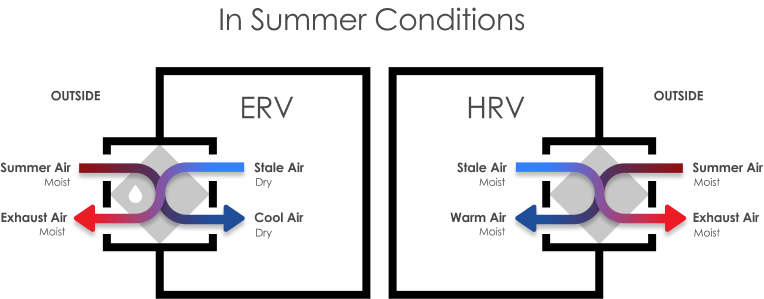
In summer conditions ERV systems work in reverse to how they work in winter, maintaining specific humidity and temperature levels by filtering out excess moisture. When excess moisture is removed from the incoming air, heat follows, leaving homes cool and dry during the humid months of the year.
Ideal for older homes, which are able to “breathe” on their own, or homes with whole-home humidifiers, HRV focuses purely on cooling the hot outside air as it enters your home and rewarming outgoing exhaust air.
If your HRV or ERV isn’t the right type for your home — or isn’t set up properly — it won’t effectively
control humidity.
Is Your HRV or ERV Actually Helping?
Even the right equipment won’t work properly if:
• It’s undersized
• It wasn’t balanced after installation
• It isn’t running consistently
• Ductwork isn’t distributing air properly
Your ventilation system needs to match how you live in your home. If it’s not configured correctly, it may not be removing enough moist air.
Is Your House Holding Its Breath?
Think of it this way:
• If old, moist air can’t get out
• And fresh, dry air can’t get in
• Your home starts holding its breath
Trapped moisture has to go somewhere, often showing up on your windows first. Modern airtight homes require properly designed mechanical ventilation more than older drafty homes. Their unsealed gaps and cracks allow for natural (but costly) airflow.
Here’s How to Fix Sweaty Windows
1. Check Your Ventilation
Ensure your HRV/ERV is the correct system, properly installed, and balanced.
2. Reduce indoor humidity sources
Use bathroom and kitchen exhaust fans, avoid drying clothes indoors, and ventilate during showers
and cooking.
3. Monitor humidity levels
Ideal winter indoor humidity is typically 30–40%. Higher levels increase condensation risk.
4. Address air distribution issues
Poor airflow can trap humid air. Air balancing may be needed.
Bottom Line
Sweaty windows are a symptom — not the root problem.
They often indicate:
• Your home isn’t getting enough fresh air
• Moisture isn’t being removed properly
• Your HRV or ERV may not be set up correctly
With proper ventilation design, air balancing, and humidity control, your home can breathe properly — and your windows can stay clear.